IFT6076 - evaluation IEML-RS

2025-12-04
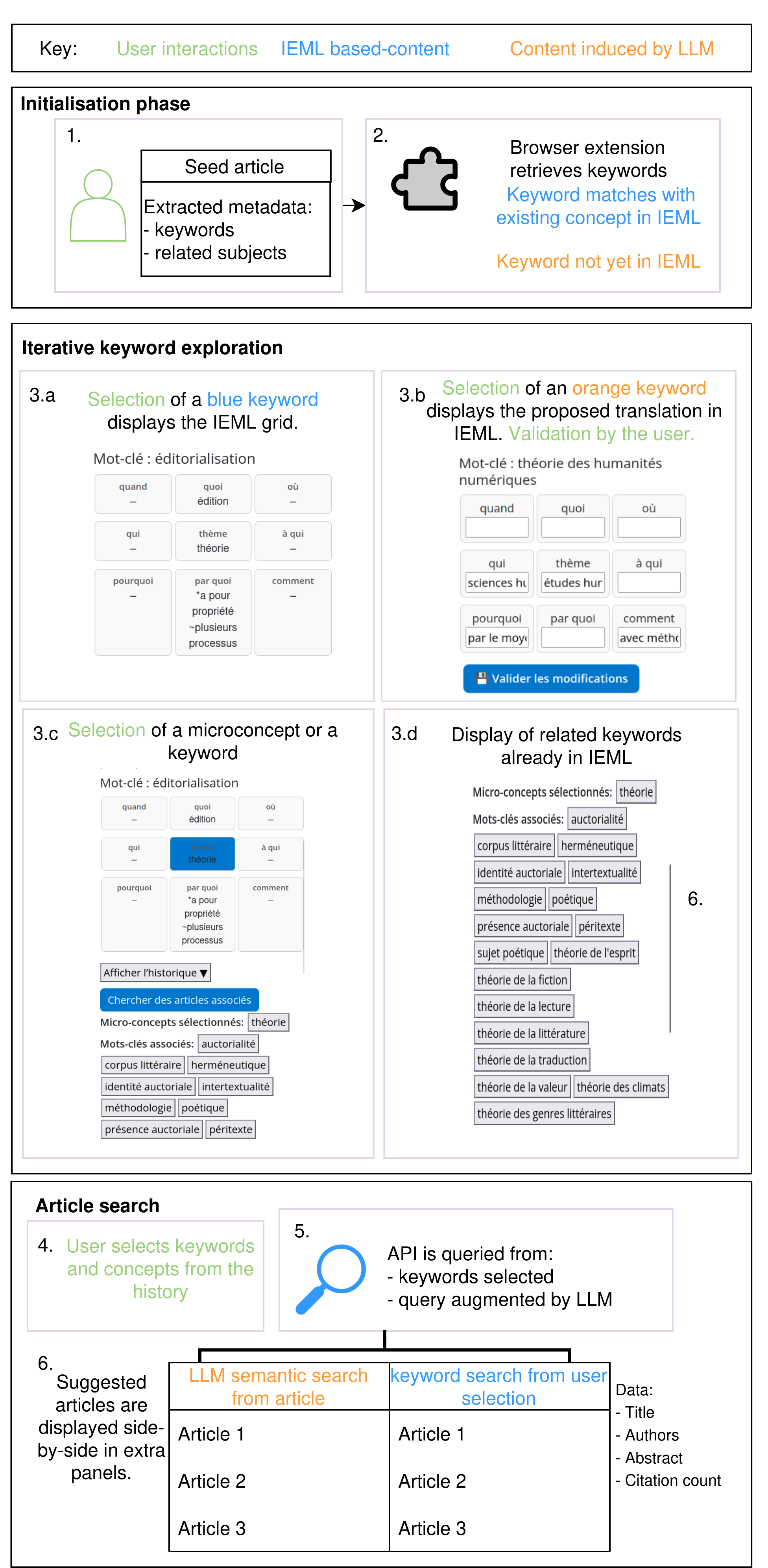
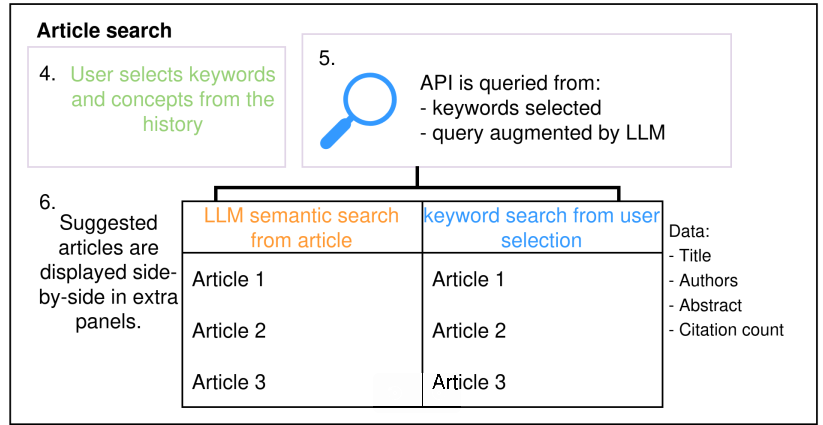
Diagram of IEML-RS
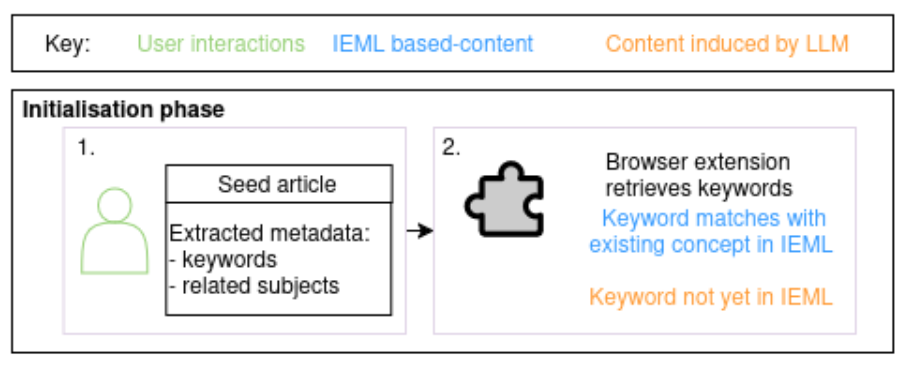
Initialisation of the plugin

Database of translated keywords: Cloudflare bucket
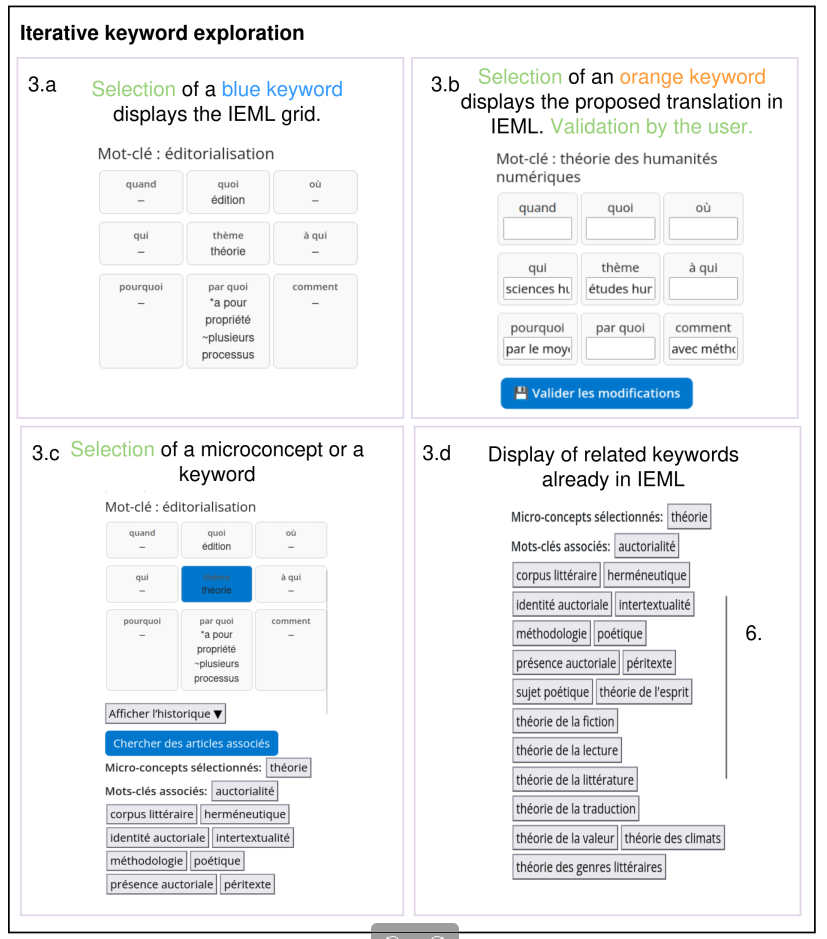
Building a Query from Iterative Keyword Exploration

  • Database of translated keywords: Cloudflare bucket
  • Database of dictionnary words (embeddings) : Supabase
  • Together AI proxy: Cloudflare worker

Searching Related Articles from User-Selected Concepts

API handler (Isidore, CrossRef): Cloudflare worker

Evaluation

Examples of expected translation

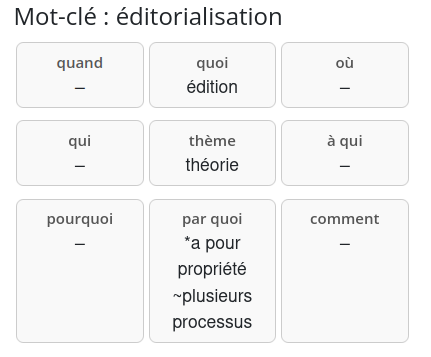
IEML grid for “éditorialisation”

Note: Translation can only use the IEML dictionnary containing (~3,000 entries).
Retrieval

Dataset: 50 words translated with 70 dictionnary entries.

Evaluation: 1 point for each word in ground truth retrieved.

strategy score
TF-iDF 15
Cosine similarity 25
Hybrid (TF-iDF + Embeddings) 23

RAG pipeline

Dataset:

full: 410 words translated

  • train (examples for fewshot): 50 words
  • test (evaluation): 360 words

Models:

  • Meta-Llama-3-70B-Instruct-Turbo
  • Gemma-3n-E4B-it,
  • GPT-oss-20B
model/strategy BLEU Cosine avg
baseline 0.056 0.515 0.286
llama_fewshot 0.0222 0.555 0.289
gemma_fewshot 0.020 0.491 0.255
openai_fewshot 0.0167 0.498 0.257
llama_zeroshot 0.0129 0.514 0.263
gemma_zeroshot 0.0160 0.479 0.248
openai_zeroshot 0.016 0.493 0.254

Context (i.e. dictionnary entries) only marginally improve performance.

Qualitative evaluation

RAG evaluation

Reminder of the expected translation.

word to translate theme or root who what to whom by what means when where why how
espace numérique technique numérique - espace - - - - - -
chanteur jouer ou chanter une mélodie personne - - *par le moyen de voix - - -

Examples of LLM-translated content (rag-llama-fewshot)

word translated theme or root who what to whom by what means when where why how
espace numérique espace cyberespace tous par internet et les réseaux sociaux - virtuellement monétiser et partager des informations
chanteur musique chanteur interprétant une chanson à un public par sa voix - - pour exprimer une émotion en utilisant des métadonnées-chanson
  • tends to fill the grid
  • do not stick to given dictionnary entries
  • do not respect the grammar

User Study

6 users (PhD students in DH). Demonstration then 10 min of observation then 15 min interview.

  • user-friendliness,
  • usefulness,
  • keyword navigation,
  • translation into IEML,
  • article search and panel comparison.

User study results: limits and perspectives

  • user-friendliness :
    • confusion about the integration of the concepts into the query
    • automatic translation & validation: initial hurdle (limited database)
    • direct integration to host search engine: main improvements (latency, more detailed info on the article, distinction between ‘query building’ and ‘article search’ functions)
  • usefulness:
    • reveals strong disparities in user research practices (etwork and contextual IR vs. keyword search)
    • strength: comparative panels,
    • translation of mixed quality encourages user-agency and dialogical and collaborative work with LLMs

Prompts

Translation prompt

Tu es un expert en sémantique. Tu dois décomposer sémantiquement le mot-clé "${keyword}" à partir des 9 valeurs suivantes :
'thème, qui, quoi, à qui, par quoi, quand, où, pourquoi, comment'
## Exemples
${examples}

## Mots du dictionnaire 
Tu dois utiliser les mots ci-dessous pour définir le mot-clé "${keyword}":
${context}

Ta réponse prendra la forme d'un CSV à 9 colonnes, les entêtes de colonnes sont: 
'thème, qui, quoi, à qui, par quoi, quand, où, pourquoi, comment'
Il n'est pas nécessaire de remplir tous les champs. Un champs peut rester vide entre deux virgules, comme dans les exemples. 
Répond uniquement avec une ligne CSV finale, sans explication.

Query augmentation prompt

Produit 10 variants de la requête booléenne suivante "${keywords}". Combine les requêtes proposées à l'aide de l'opérateur OU comme dans l'exemple : Mots-clés:  "impact of climate change on biodiversity". Réponse: "
(climate change biodiversity impact) OU (effects of climate change on ecosystems) OU (biodiversity loss due to climate change) OU (climate change species extinction) OU (impact of global warming on wildlife) OU (effects of climate change on ecosystems and species diversity) OU (how climate change impacts wildlife and biodiversity) OR (climate change consequences for biological diversity) OU (relationship between climate change and loss of biodiversity) OU (climate change threats to flora and fauna diversity) OU (impact of climate change on biodiversity)
C'est à ton tour avec "${keywords}". Répond uniquement avec la requête sans donner d'explication.

Demonstration without sound

Screenshots

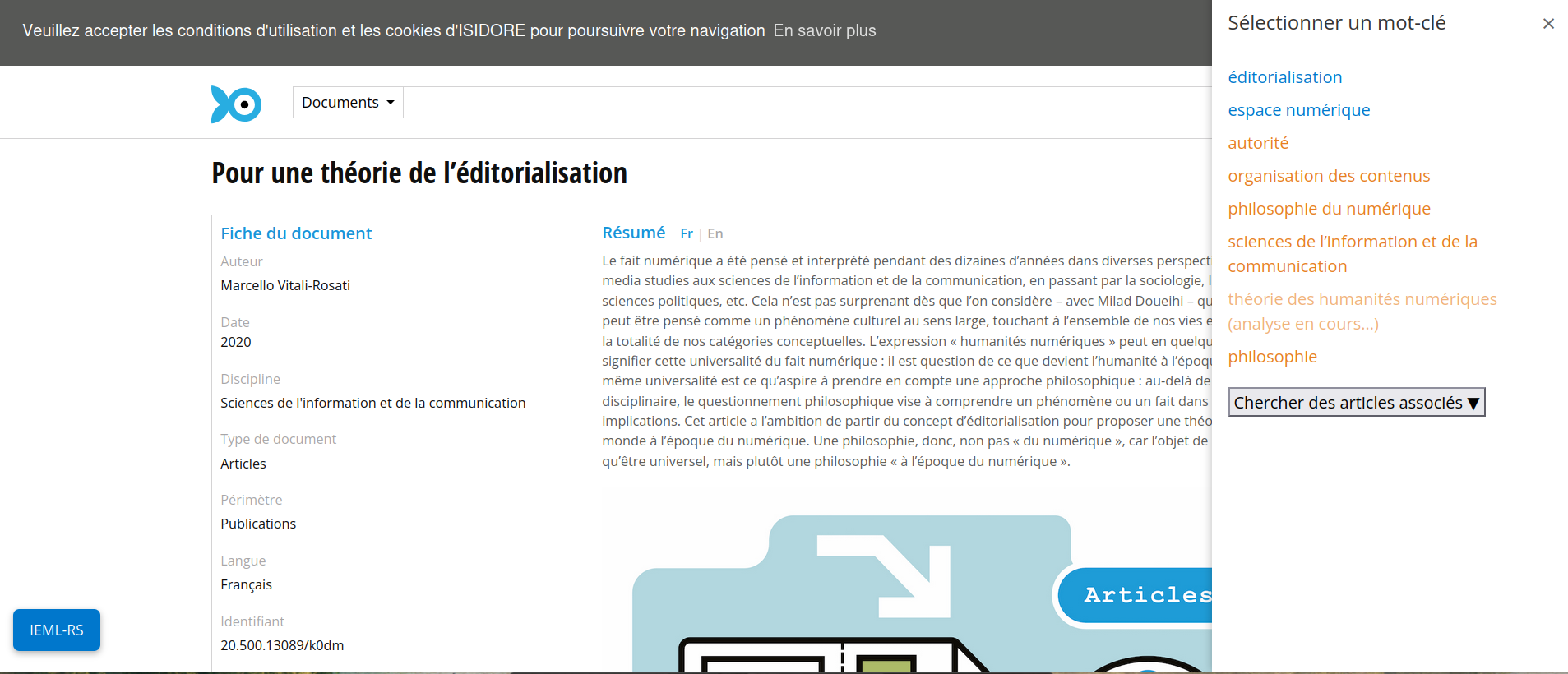
First step: from seed article, the panel opens and retrieves the article keywords
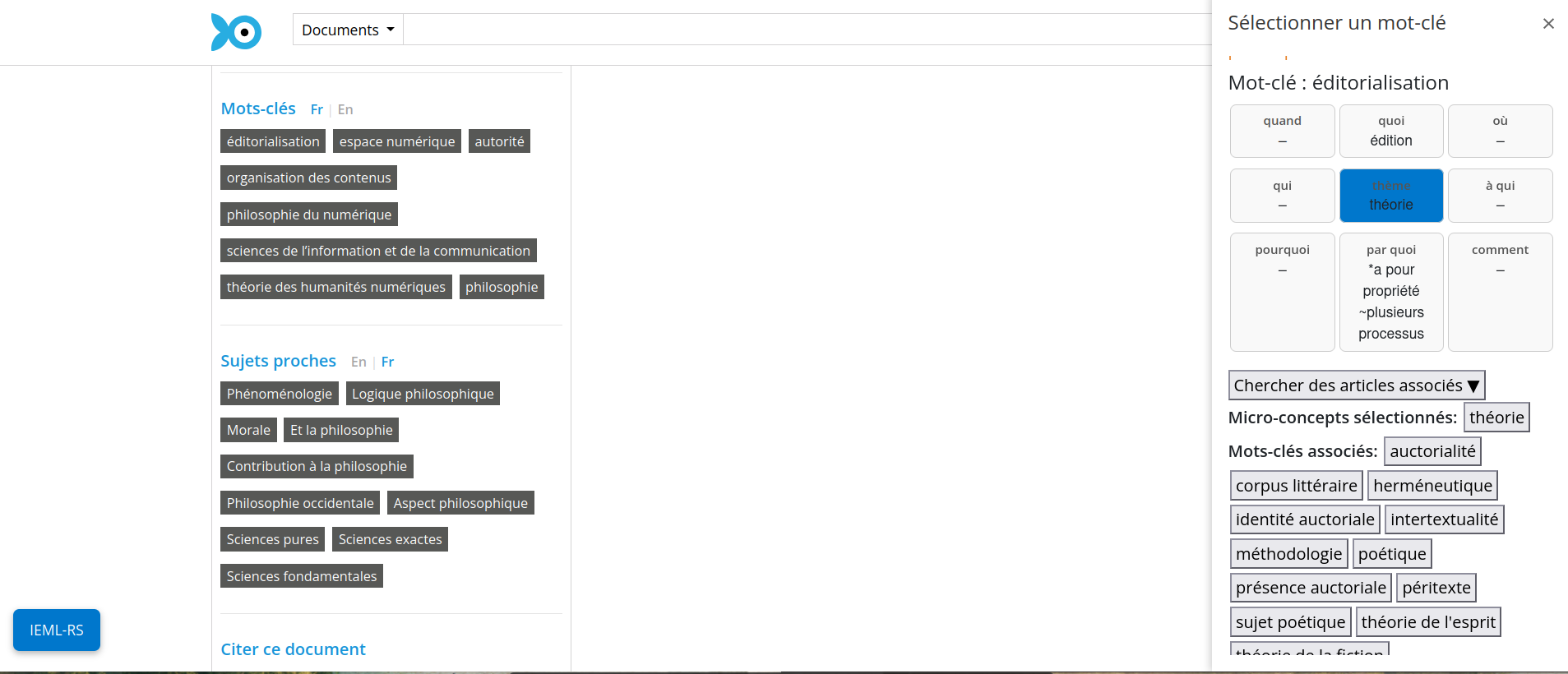
User can select a keyword already translated in IEML (in blue), displaying the grid containing concepts defining the keyword
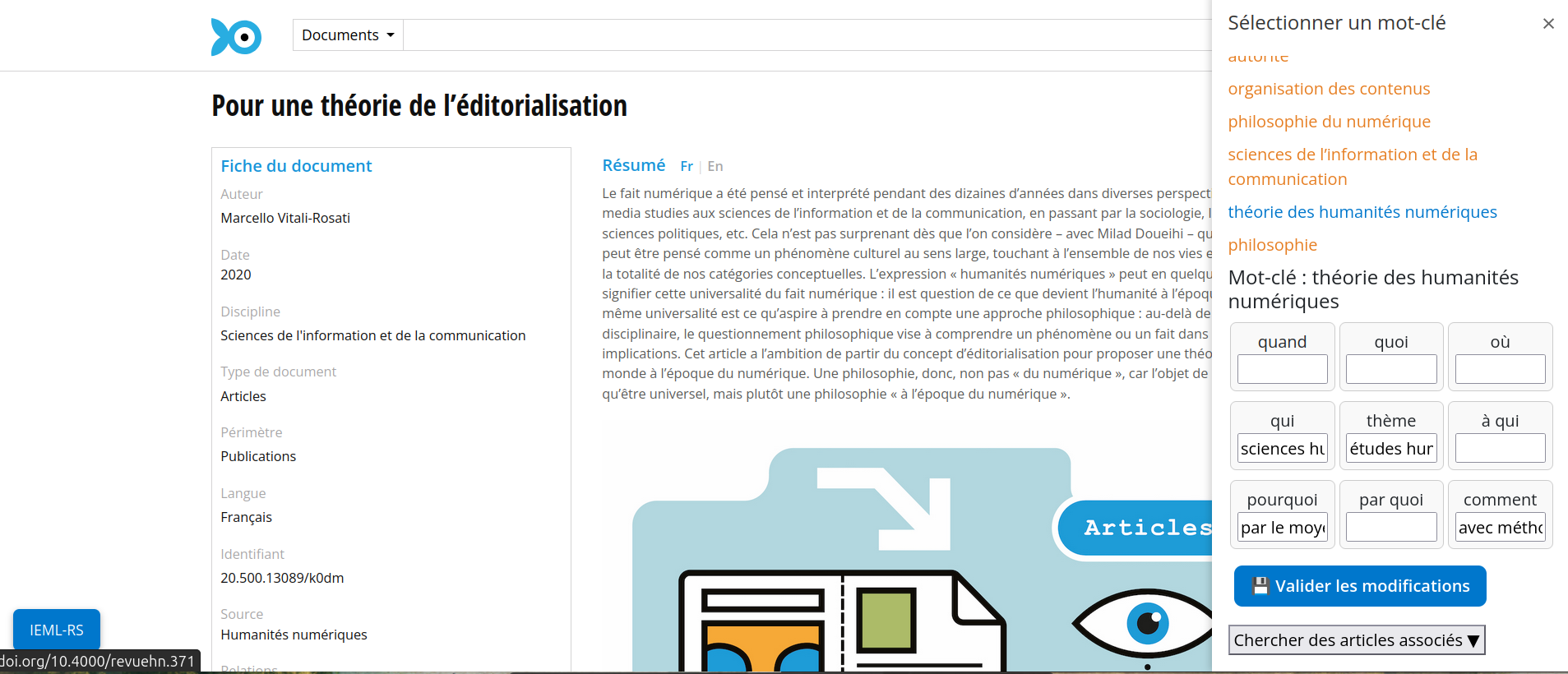
If the keyword hasn’t been translated a LLM translation is suggested (from the IEML dictionnary) and user can modify it
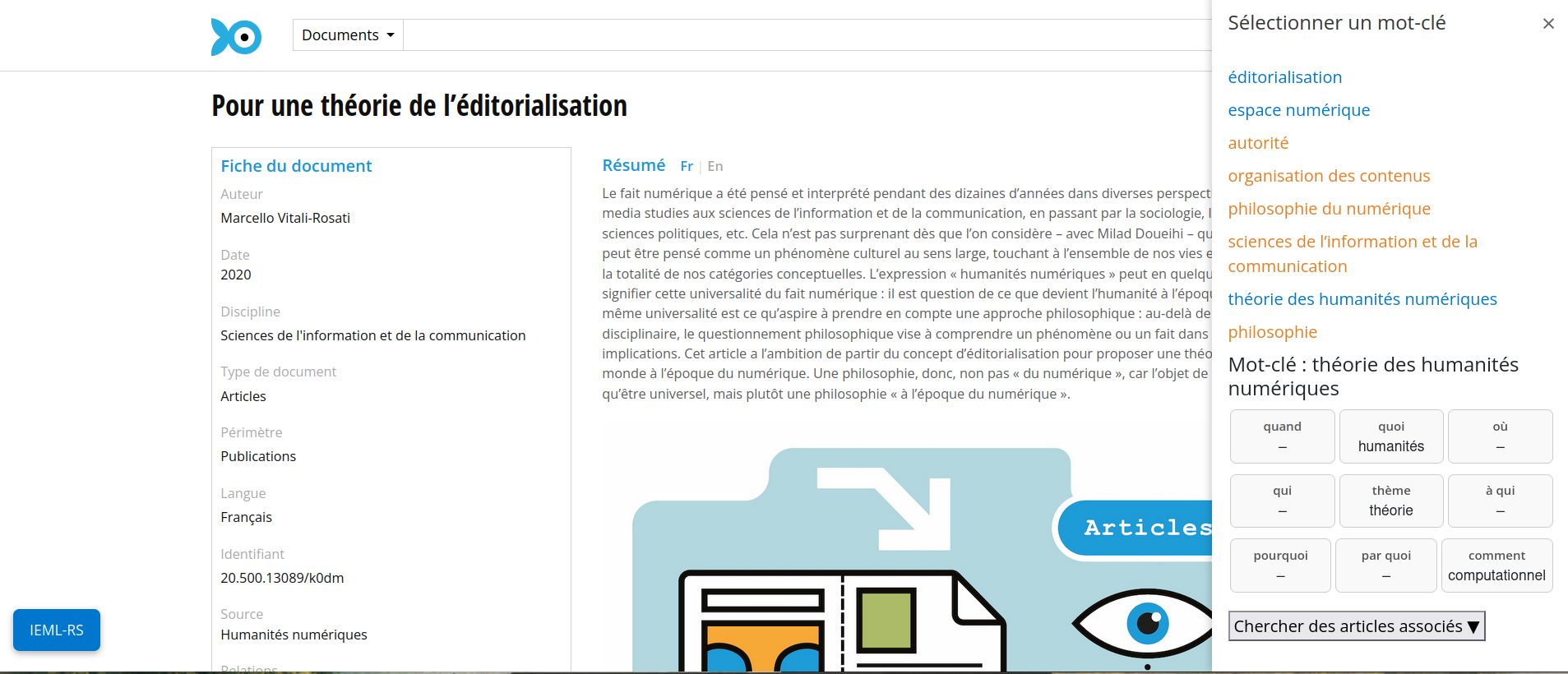
After validation of the translation, the translation is added to the IEML database
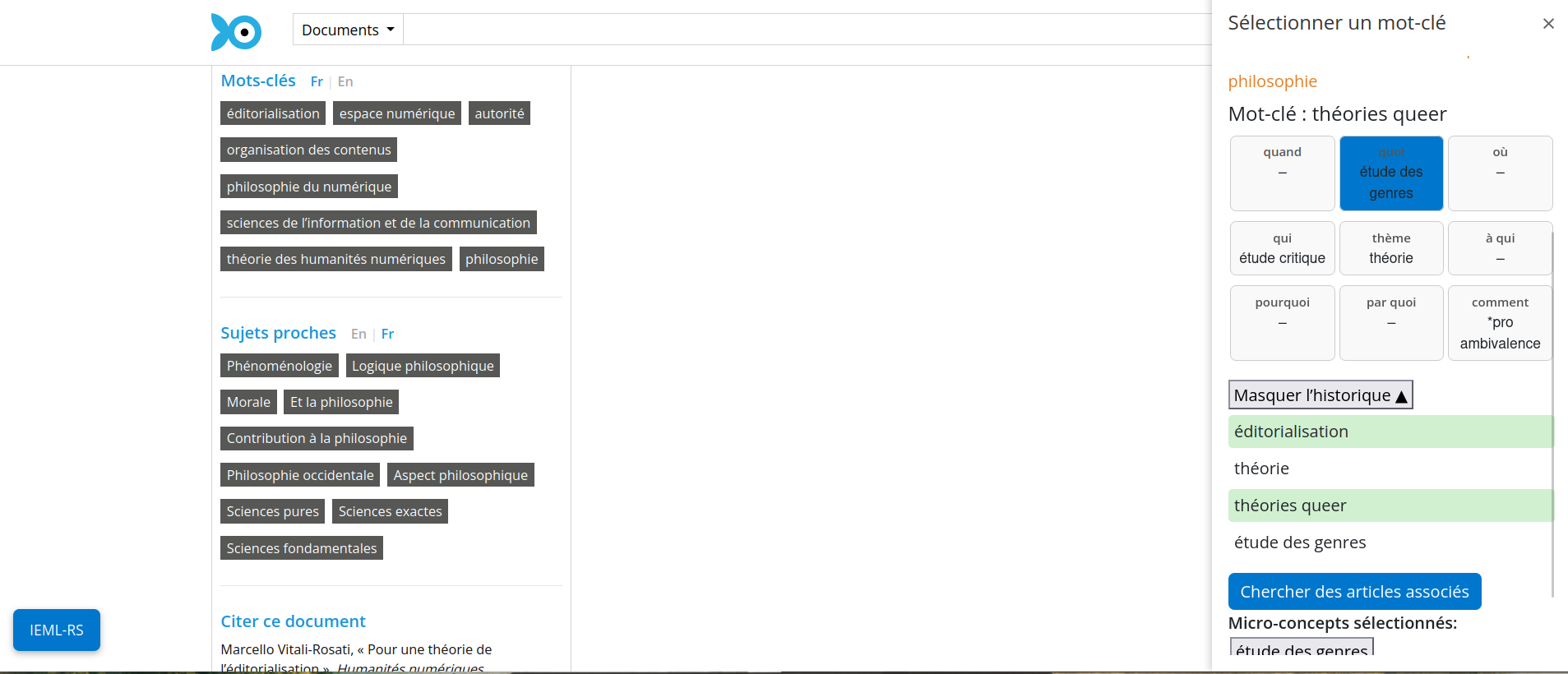
User can build a query from selected concepts and keywords
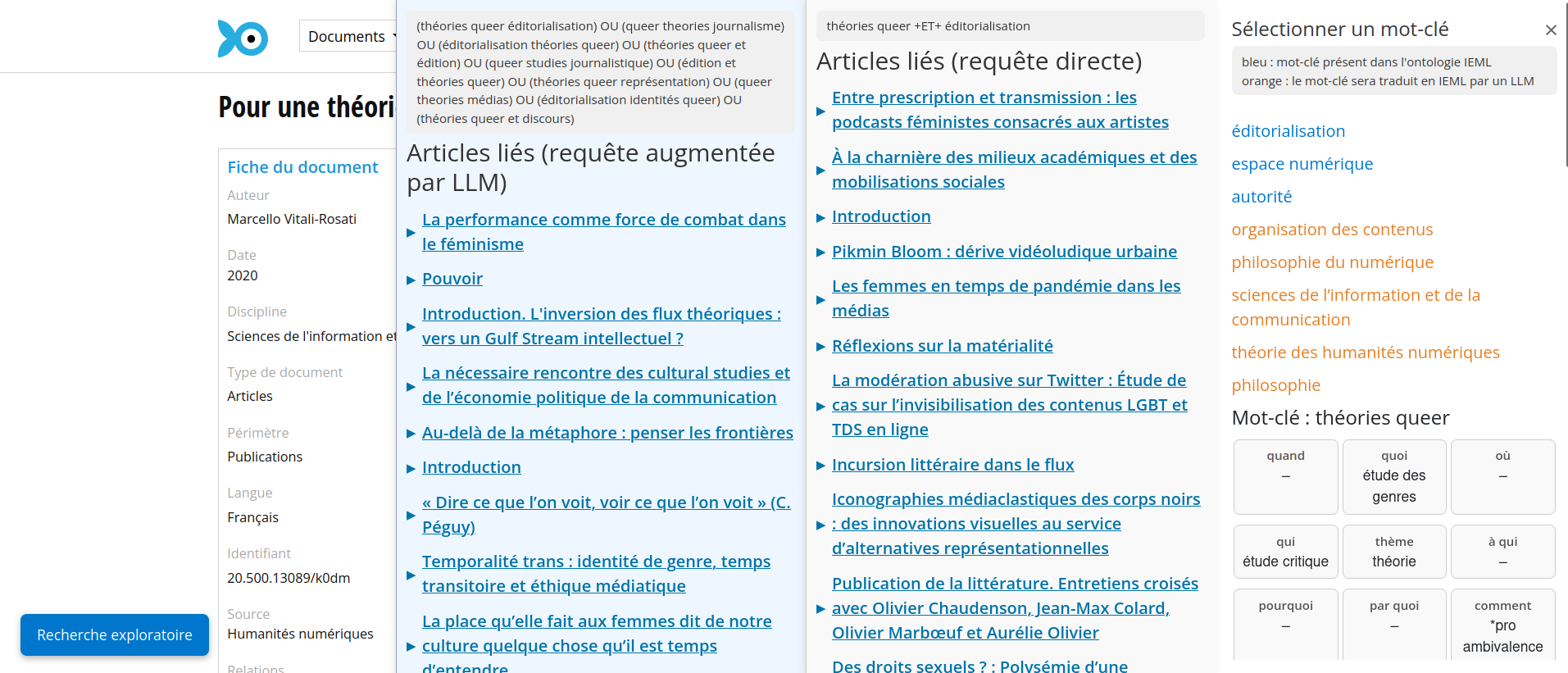
The query returns 2 lists of articles, one from the keywords selected and one from a query augmentation of those keywords