C2DH - Understanding current AI tools’ impact on research and developping alternative AI tools

2026-04-14

Current research interests

Context

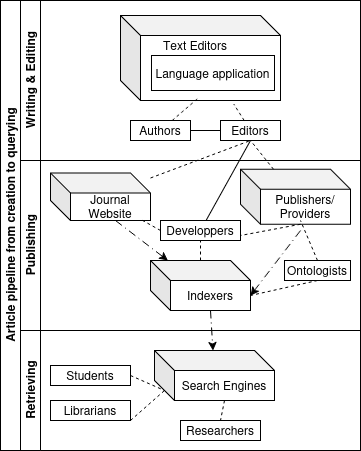
An ecosystem in 3 parts :

  1. Writing and editing -> text editors : Authors, Editors of journals
  2. Publishing and indexing -> diffuseurs (journal providers), search engines : Developpers, Ontologists
  3. Querying et Retrieving -> search engines : Developpers, Researchers, Students

How is the research ecosystem influenced by inductive algorithms and current AI tools in the pipeline of production-to-query-of-articles ?

Scientific publishing Ecosystem : interactions between people and digital tools

AI tools as oracle

  • black box effect
  • the 🪄✨ sparkles ✨🪄
  • the blank box (Tay 2026) : natural language interactions and sleek UX.

Some issues with LLM-based apps and functionalities

  1. Writing and editing: standardisation of language and ideasé
  2. Publishing and indexing: citation concentration (de Solla Price 1963; Merton 1968), black box algorithms.
  3. Querying and retrieving: confirmation bias, filter bubbles (Pariser 2011)

Bonus: data sovereignty, uncertain foundation of science on good-faith.

New biases or exercerbation of already existing dynamics?

A Paradigmatic issue

LLMs are based on the distributional hypothesis (Harris 1981):

You shall know a word by the company it keeps. — Firth (1962)

vs. for instance generative linguistics:

Colorless green ideas sleep furiously — Chomsky (1957)

In the context of writing and information retrieval: is the most probable output the most relevant output?

Discoverability/Découvrabilité

Findability/Trouvabilité

Serendipity/Trouvaille : ‘browsing’ is a 4 dimensions process (Rice, McCreadie, and Chang 2001) : 1. the act of scanning; 2. the presence or absence of purpose; 3. the specificity of search outcomes or goals; 4. and knowledge about the resource and object sought.

Modelisation of serendipity with reflexive intent (Makri and Blandford 2012)

Serendipity is a process rather than a goal, and this process implies necessarily a selection step based on complex cognitive connexions between past and present information.

Putting serendipity at the forefront of dedicated research and writing tools can be a way to 1. reconnect digital tools and the internet to its roots (open exploration based on a network of unrelated data) 2. allow human agency to be exercised and a support for ai litteracy.

Main goals

  • Expliciting the biases, improving on AI- and digital- literacy.
  • Suggesting epistemic alternatives : e.g. valorisation of serendipity and corrections as an engagement strategy vs. personalization of interactions.
  • Developping tools and functionnality materialising this theoretical standpoint :
    1. Semantic enriching with LOD embedded in the text : text editor Stylo
    2. Alternative exploration of large corpora on qualitative aspects (e.g. citation dis/agreement) : journals, érudit, OpenEdition, Isidore.
    3. Querying strategy using semantic structured data (via IEML) as opposed to natural language : Isidore.

Stylo and LOD

Dis/agreement on citational network : Itineraires use case

Recommender System : IEML-RS for Isidore.

Bibliography

Chomsky, Noam. 1957. Syntactic Structures.
de Solla Price, Derek John. 1963. Little Science, Big Science. George B 1962. New York: Columbia University Press.
Firth, John Rupert. 1962. Studies in Linguistic Analysis. Repr. Special Volume of the Philological Society. Oxford: Blackwell.
Harris, Zellig S. 1981. “Distributional Structure.” In Papers on Syntax, edited by Zellig S. Harris and Henry Hiż, 3–22. Dordrecht: Springer Netherlands. https://doi.org/10.1007/978-94-009-8467-7_1.
Makri, Stephann, and Ann Blandford. 2012. “Coming Across Information Serendipitously – Part 1: A Process Model.” Journal of Documentation 68 (5): 684–705. https://doi.org/10.1108/00220411211256030.
Merton, R. K. 1968. “The Matthew Effect in Science. The Reward and Communication Systems of Science Are Considered.” Science (New York, N.Y.) 159 (3810): 56–63.
Pariser, Eli. 2011. “The Filter Bubble: What the Internet Is Hiding from You.” In.
Rice, Ronald E., Maureen McCreadie, and Shan-Ju Chang. 2001. “Results: Motivating Themes and Patterns of Browsing.” In Accessing and Browsing Information and Communication. The MIT Press. https://doi.org/10.7551/mitpress/1066.001.0001.
Tay, Aaron. 2026. “The Blank Box Problem: Why It’s Harder Than Ever to Know What to Type Into an AI Search Bar.” Substack Newsletter. Aaron Tay’s Musings about Librarianship.