2026-07-30
Larger context of the research: Scientific documentary research (esp. for SSH researchers)
Recommendation systems have changed: from algorithms that extracted “you might also like” suggestions alongside search engine results to tools that support natural language queries and provide full reports.
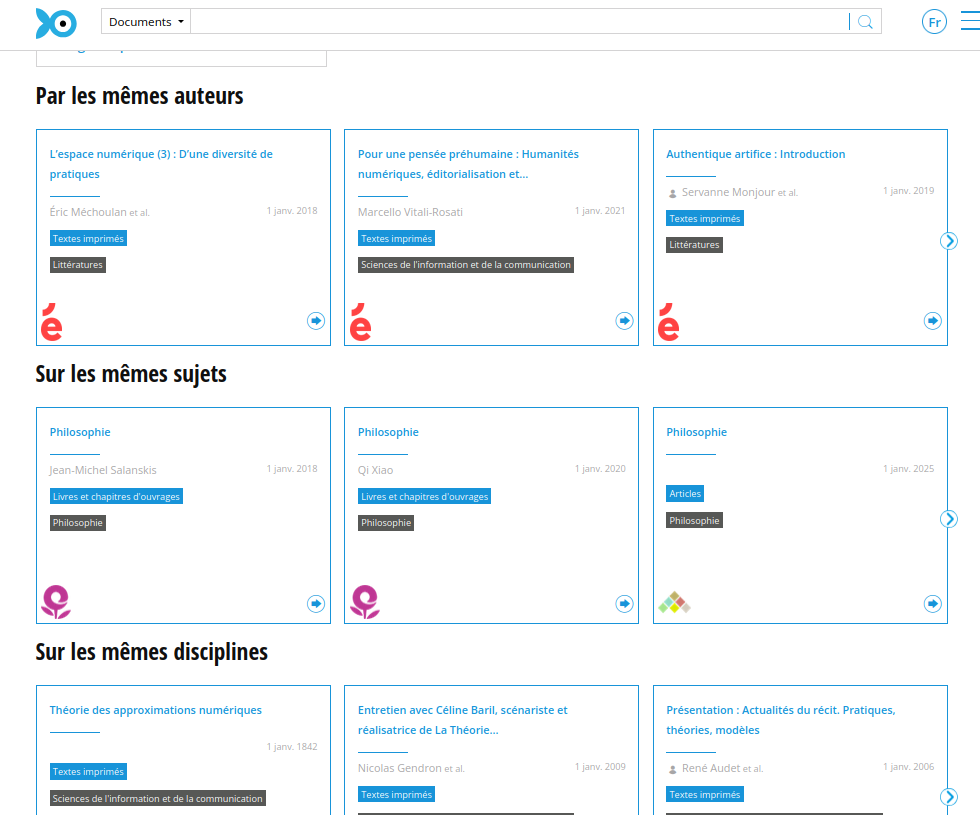
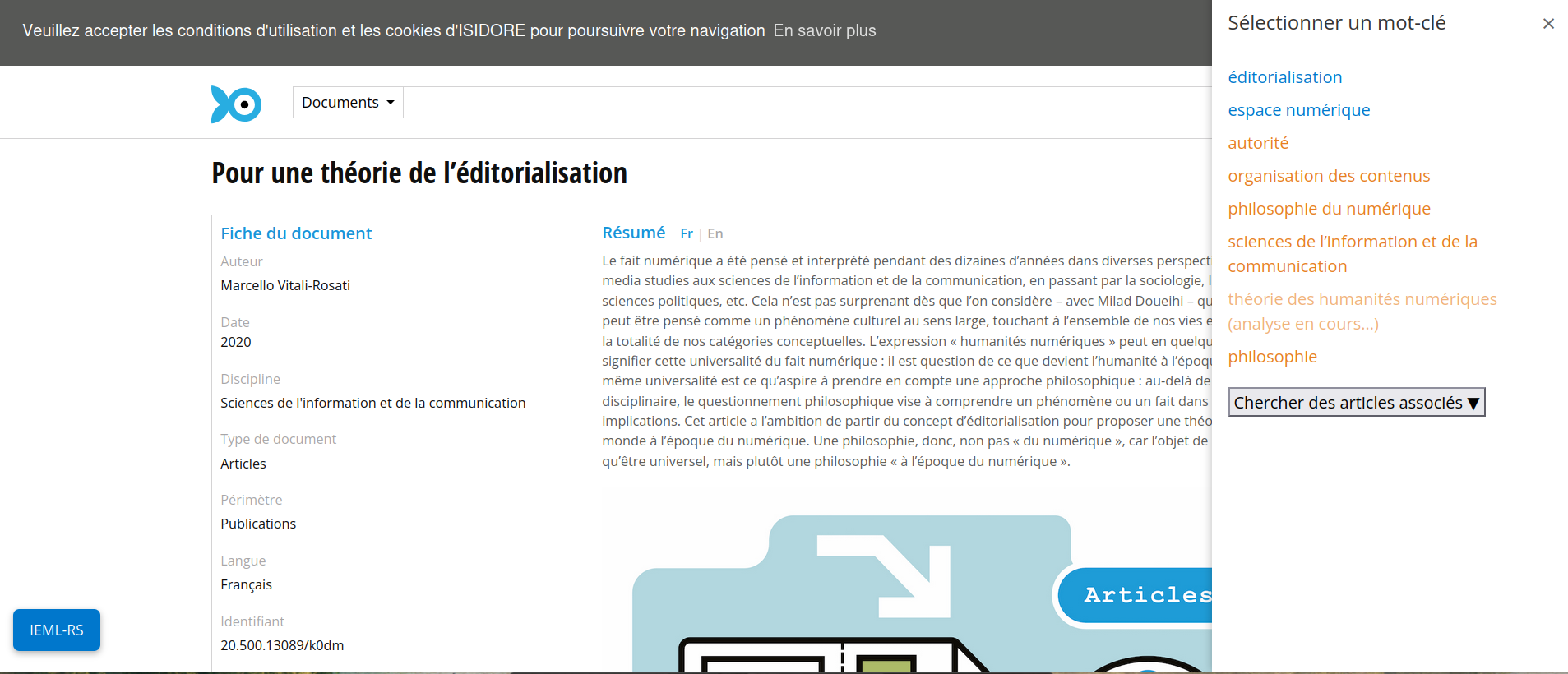
Screenshot of Isidore and standard suggested article functions
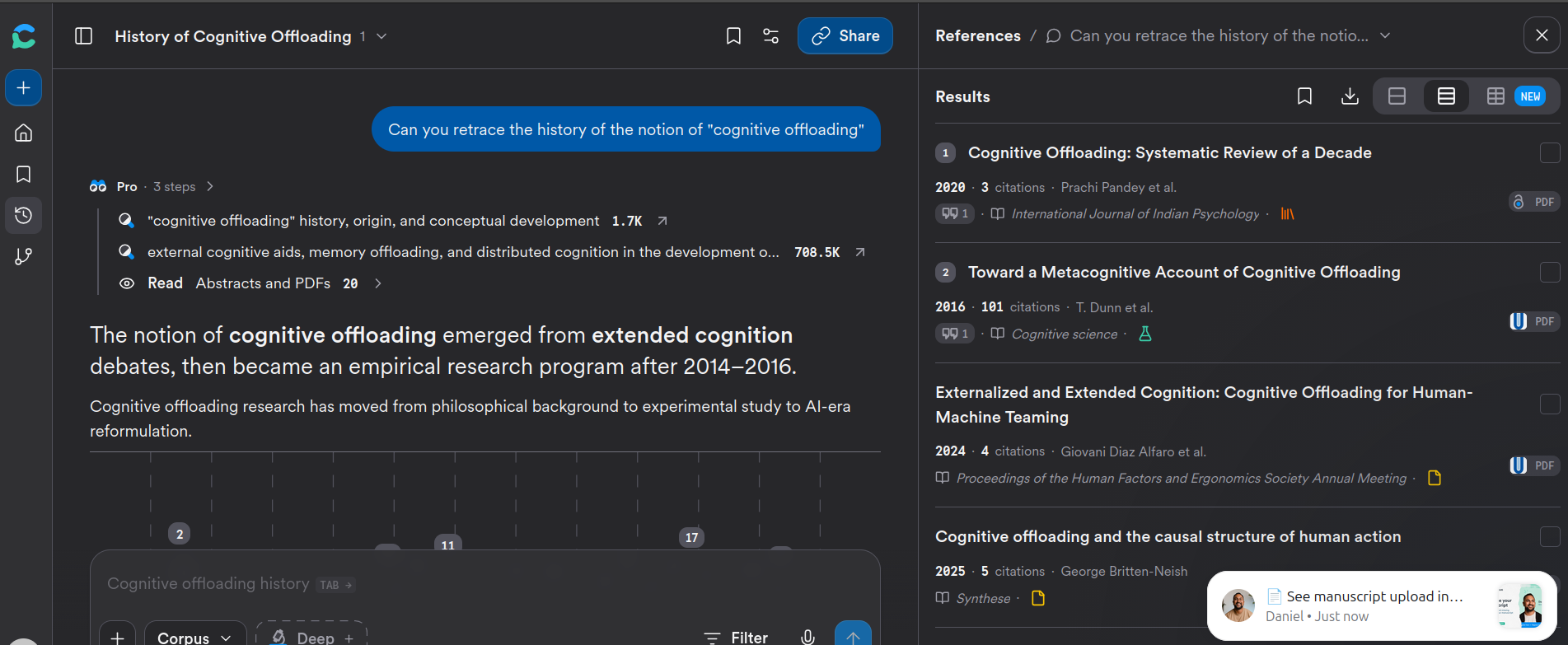
Screenshot of Consensus.app. Support for natural language queries, combining all research steps (retrieval, ranking, synthesis)
With the current adoption of these “AI research assistants” we are seeing a change in research practices. With it comes certain aspects that we have still to grapple with:
How can we design explainable systems situated at the center of an environment that fosters critical exploration and enables intellectual engagement with the algorithm?
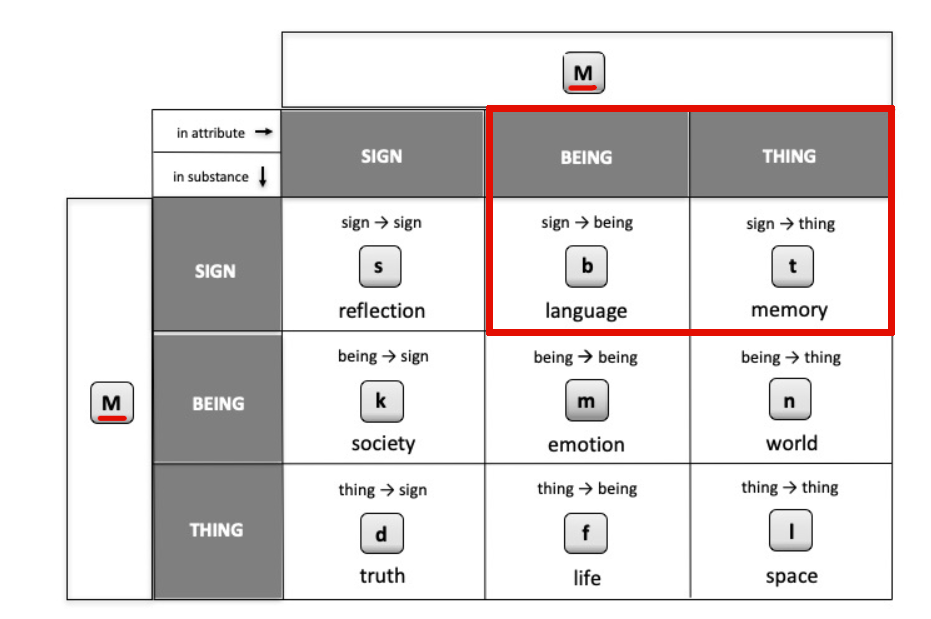
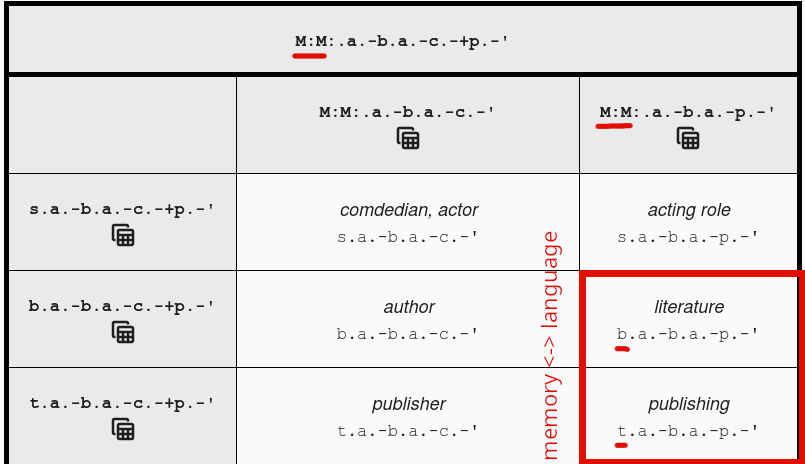
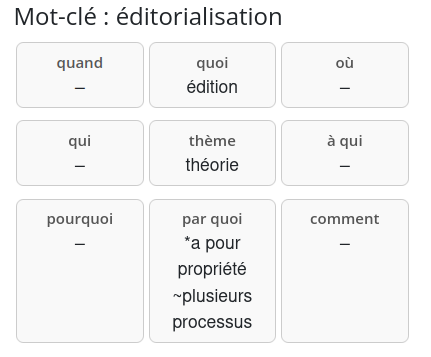
Bridger by Portenoy et al. (2022) exposes researchers to authors outside their usual intellectual networks to promote disciplinary cross-pollination.VITALITY by Narechania et al. (2022) proposes a literature review approach based on visualization of word embedding space from a seed article.STAK by Martin, Greenspan, and Quan-Haase (2017) was inspired by the material affordances of physical libraries, attempting to recreate spatialized navigation environments.Information Economy MetaLanguage (IEML) (Lévy 2023) != YAML
| Semantic Facet | Value |
|---|---|
| Theme/root | theory (s.y.-g.-o.p.-’) |
| What | edition or publishing (t.a.-b.a.-p.-’) |
| Who | - |
| To whom | - |
| By which means | *has property ~multiple process |
| When | - |
| Where | - |
| Why | - |
| How | - |
Rules :
Rules:


English version:
You are a semantics expert. You must semantically decompose the keyword “${keyword}” based on the following 9 values: ‘theme, who, what, to whom, by what means, when, where, why, how’ ## Examples ${examples}
## Dictionary Words You must use the words below to define the keyword “${keyword}”: ${context}
Your response must take the form of a CSV with 9 columns; the column headers are: ‘theme, who, what, to whom, by what means, when, where, why, how’ It is not necessary to fill all fields. A field can remain empty between two commas, as in the examples. Respond only with a final CSV line, without explanation.
Original in French:
Tu es un expert en sémantique. Tu dois décomposer sémantiquement le mot-clé "${keyword}" à partir des 9 valeurs suivantes :
'thème, qui, quoi, à qui, par quoi, quand, où, pourquoi, comment'
## Exemples
${examples}
## Mots du dictionnaire
Tu dois utiliser les mots ci-dessous pour définir le mot-clé "${keyword}":
${context}
Ta réponse prendra la forme d'un CSV à 9 colonnes, les entêtes de colonnes sont:
'thème, qui, quoi, à qui, par quoi, quand, où, pourquoi, comment'
Il n'est pas nécessaire de remplir tous les champs. Un champs peut rester vide entre deux virgules, comme dans les exemples.
Répond uniquement avec une ligne CSV finale, sans explication.
English version:
Generate 10 variants of the following Boolean query “${keywords}”. Combine the proposed queries using the OR operator as in the example:
Keywords: “impact of climate change on biodiversity”.
Response: “(climate change biodiversity impact) OR (effects of climate change on ecosystems) OR (biodiversity loss due to climate change) OR (climate change species extinction) OR (impact of global warming on wildlife) OR (effects of climate change on ecosystems and species diversity) OR (how climate change impacts wildlife and biodiversity) OR (climate change consequences for biological diversity) OR (relationship between climate change and loss of biodiversity) OR (climate change threats to flora and fauna diversity) OR (impact of climate change on biodiversity) Now it is your turn with”${keywords}“.
Respond only with the query without giving any explanation.
Original in French::
Produit 10 variants de la requête booléenne suivante "${keywords}". Combine les requêtes proposées à l'aide de l'opérateur OU comme dans l'exemple : Mots-clés: "impact of climate change on biodiversity". Réponse: "
(climate change biodiversity impact) OU (effects of climate change on ecosystems) OU (biodiversity loss due to climate change) OU (climate change species extinction) OU (impact of global warming on wildlife) OU (effects of climate change on ecosystems and species diversity) OU (how climate change impacts wildlife and biodiversity) OR (climate change consequences for biological diversity) OU (relationship between climate change and loss of biodiversity) OU (climate change threats to flora and fauna diversity) OU (impact of climate change on biodiversity)
C'est à ton tour avec "${keywords}". Répond uniquement avec la requête sans donner d'explication.
| word to translate | theme or root | who | what | to whom | by what means | when | where | why | how |
|---|---|---|---|---|---|---|---|---|---|
| digital space | digital technique | - | space | - | - | - | - | - | - |
| singer | play or sing a melody | person | - | - | *by means of voice | - | - | - |
Expected translation
| word translated | theme or root | who | what | to whom | by what means | when | where | why | how |
|---|---|---|---|---|---|---|---|---|---|
| digital space | space | cyberspace | everyone | via internet and social networks | - | virtually | monetize and share information | ||
| singer | music | singer | performing a song | to an audience | by their voice | - | - | to express an emotion | using song metadata |
Examples of translations produced by rag-llama-fewshot.
LLMs still do not perform well for structured meaning representation e.g. with Abstract Meaning Representation (AMR) (Ettinger et al. 2023).
Models (via Together AI API):
| model/strategy | BLEU | Cosine | avg |
|---|---|---|---|
| baseline | 0.056 | 0.515 | 0.286 |
| llama_fewshot | 0.0222 | 0.555 | 0.289 |
| gemma_fewshot | 0.020 | 0.491 | 0.255 |
| openai_fewshot | 0.0167 | 0.498 | 0.257 |
| llama_zeroshot | 0.0129 | 0.514 | 0.263 |
| gemma_zeroshot | 0.0160 | 0.479 | 0.248 |
| openai_zeroshot | 0.016 | 0.493 | 0.254 |
The context (i.e., dictionary entries) marginally improves performance.
Limits:
6 users (PhD in Digital Humanities). Demonstration followed by 10 minutes of usage observation and a 15-minute interview.
Criteria:
Features:
Example of an environment design fostering serendipity.
Tools being developed in Digital Humanities:
Research funded by the SSHRC through the Revue3.0 partnership project, as well as a fellowship from the Circé Network and the Publica Coalition for mutualization and research on scientific journals.
Link to download the Firefox plugin:

First step: from seed article, the panel opens and retrieves the article keywords
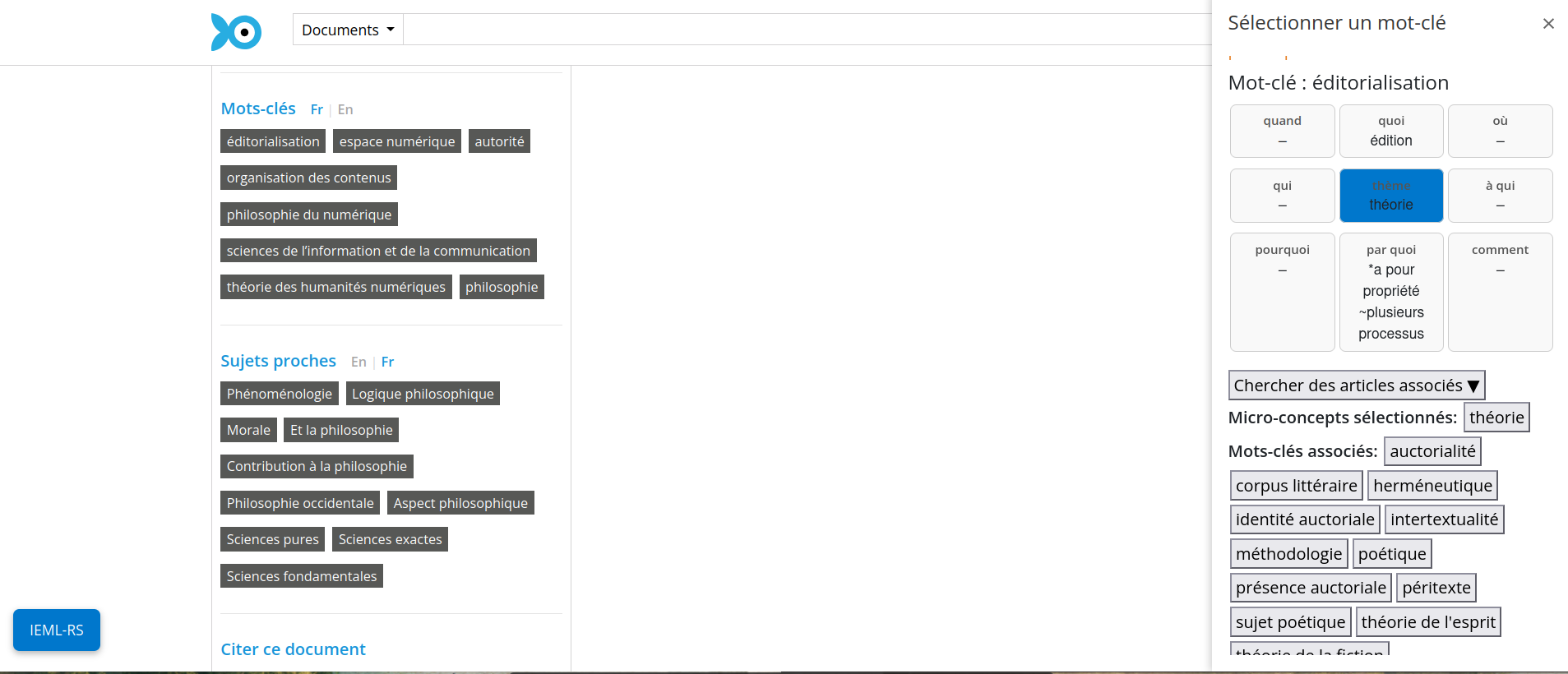
User can select a keyword already translated in IEML (in blue), displaying the grid containing concepts defining the keyword
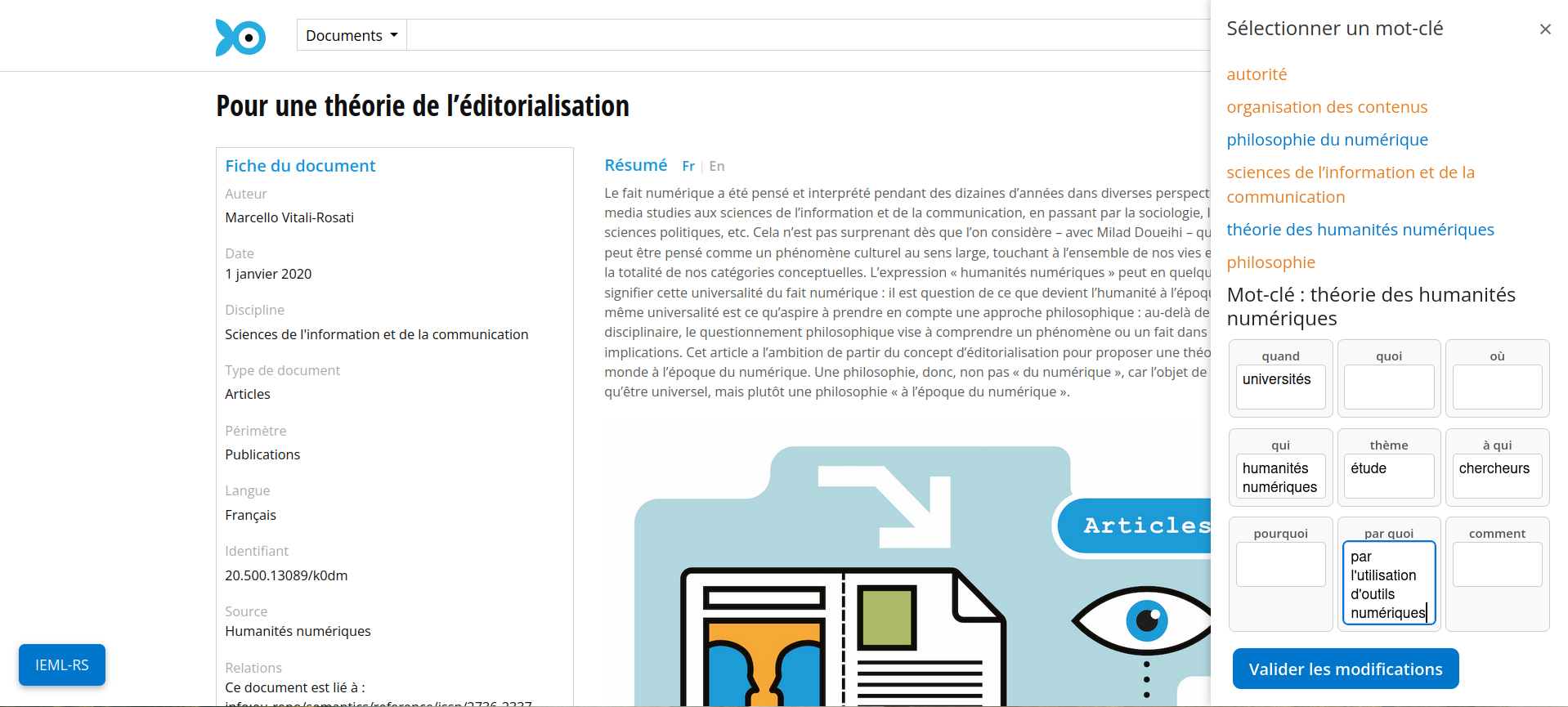
If the keyword hasn’t been translated a LLM translation is suggested (from the IEML dictionnary) and user can modify it
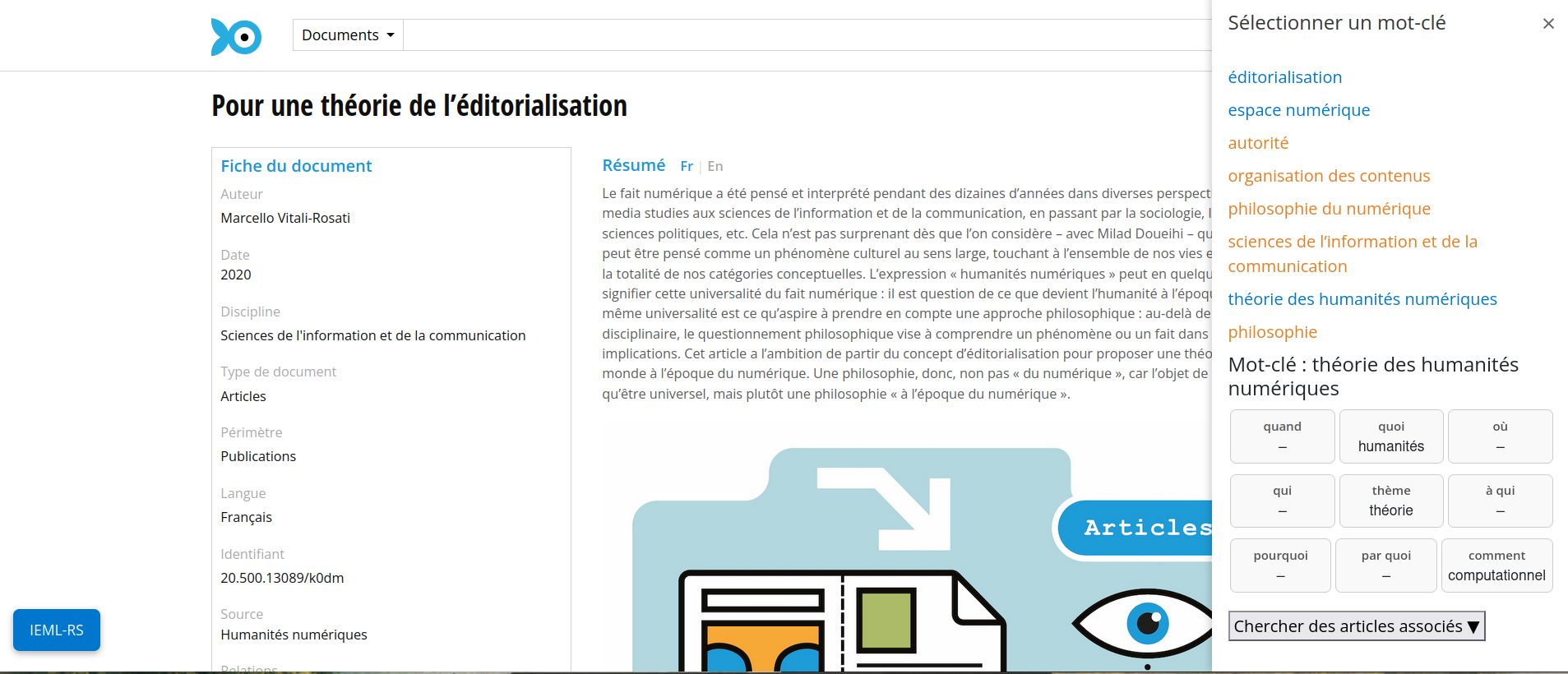
After validation of the translation, the translation is added to the IEML database
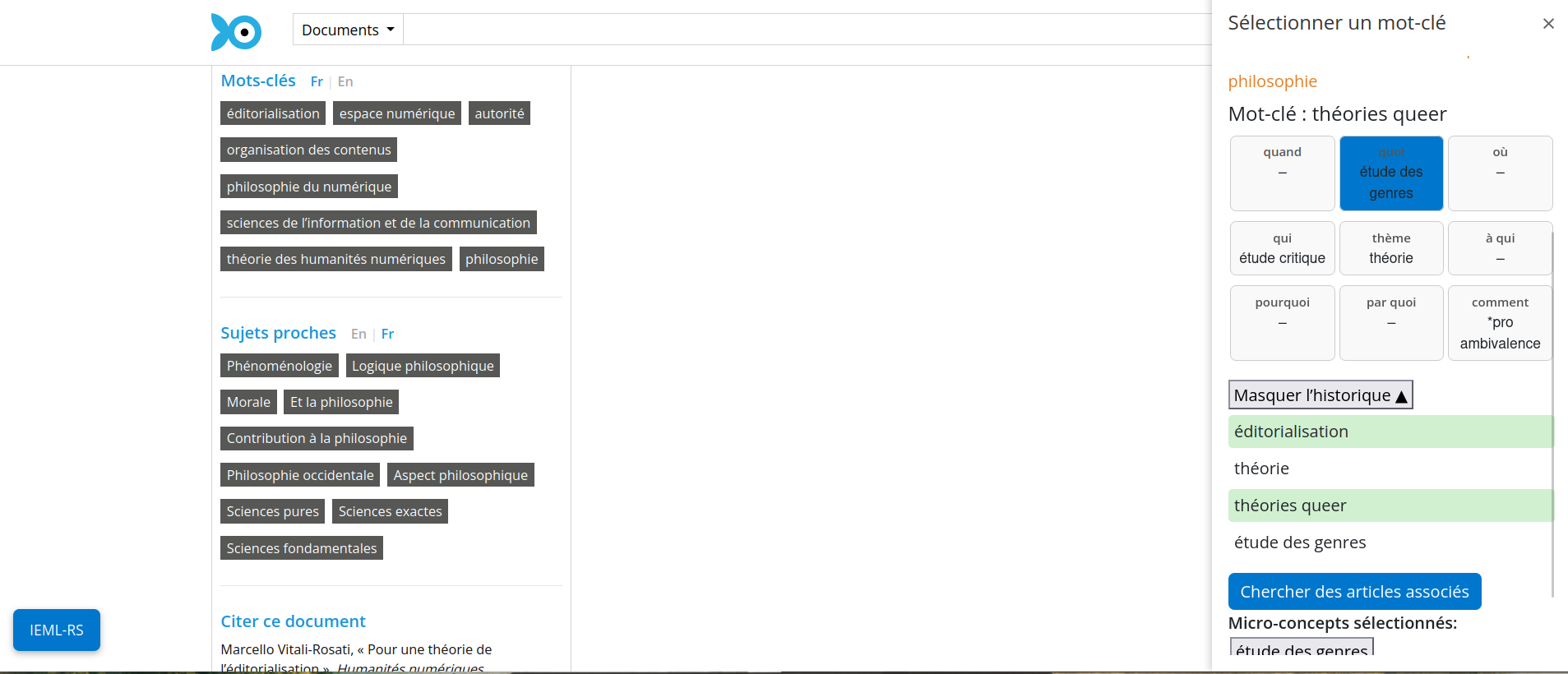
User can build a query from selected concepts and keywords
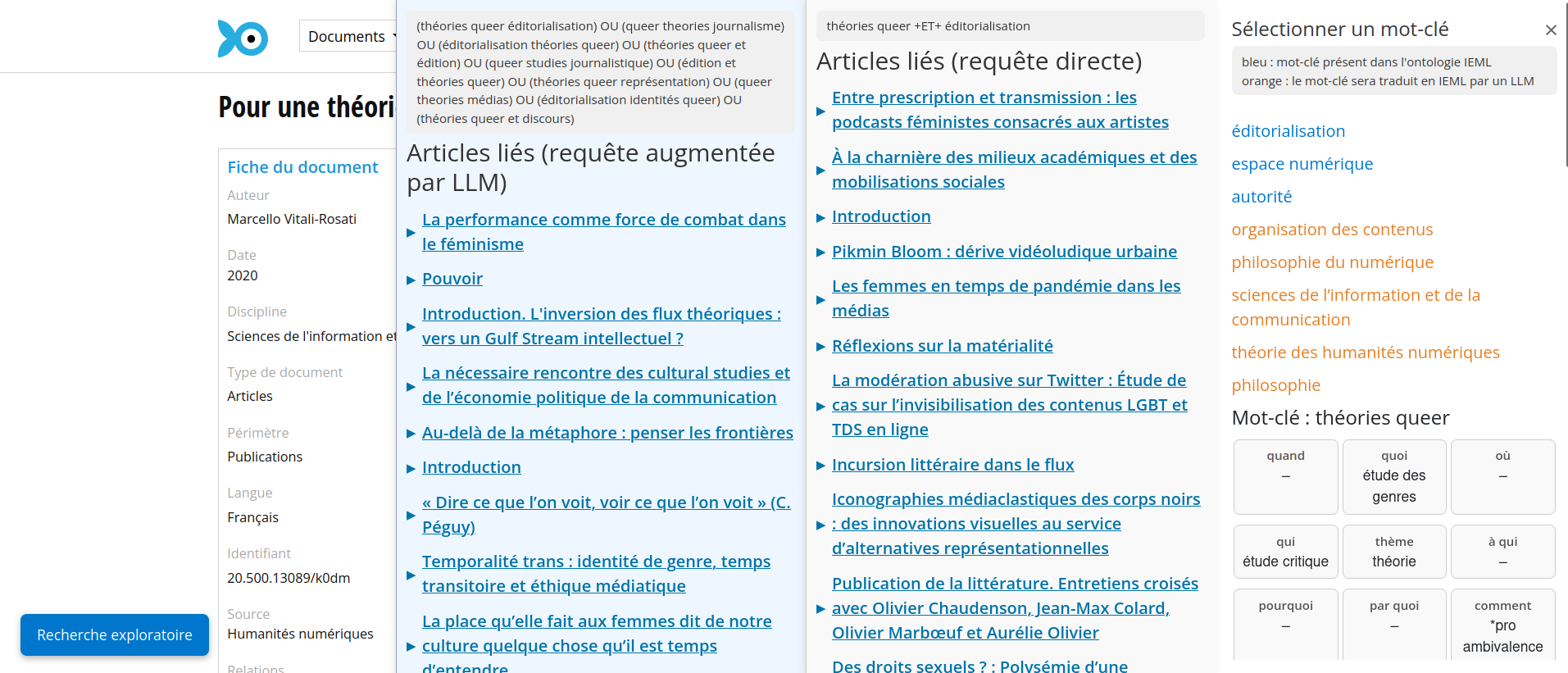
The query returns 2 lists of articles, one from the keywords selected and one from a query augmentation of those keywords

Alexia Schneider - 2026